

THE GHOST OF CHRISTMAS PAST
The Hammer became aware of General Patton the way a man became aware of incoming artillery, not through sound, but through certainty. The air behind him tightened. The room seemed to shrink by inches. The roastery’s quiet stopped feeling like quiet and started feeling like negligence with overhead lighting.
He did not turn around at first. The Hammer preferred to let intruders sit in their own poor decision for a moment, even supernatural ones. He stared at the empty floor, at the idle machines, at the chairs that were arranged acceptably but not with enough fear in their alignment.
“Colonel,” a voice said, amused and sharp, “you’re lingering.”
The Hammer straightened reflexively, posture correcting itself before pride could interfere. When he turned, irritation evaporated into something closer to reverence and professional envy. General George S. Patton stood in the roastery as if history had opened a door for him and then immediately regretted it. Boots planted. Riding crop loose in his hand. Eyes tuned to weakness the way some men were tuned to music.
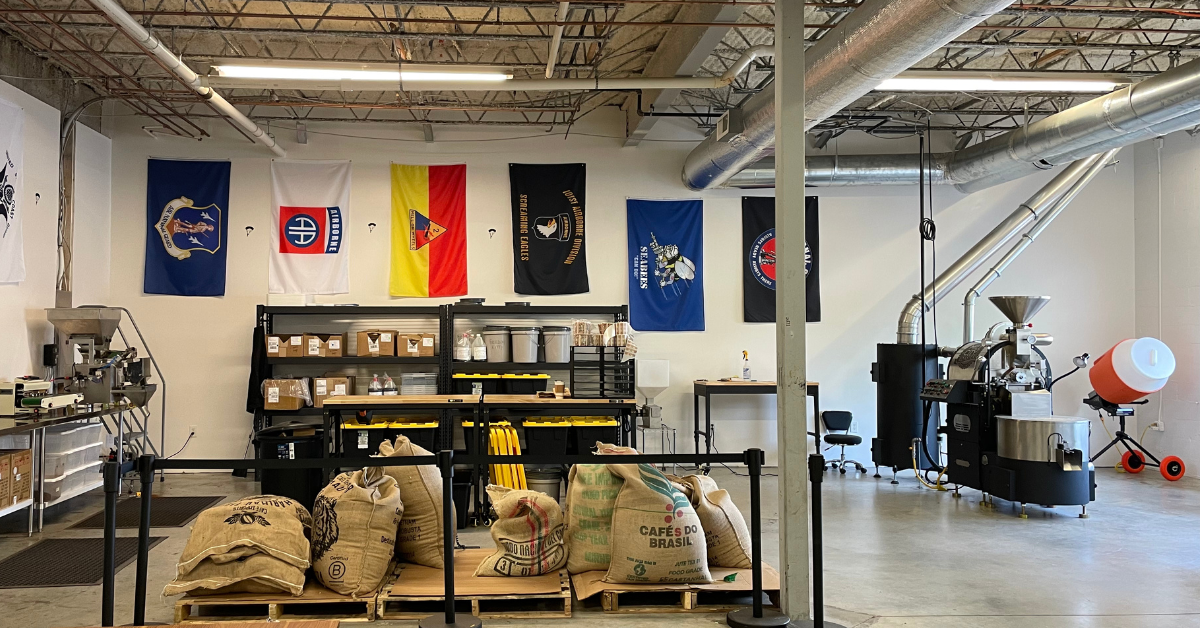
Patton looked around with open contempt, taking in the stainless steel, the exposed brick, the smell of coffee, and the unmistakable softness of modern lighting.
“This place smells like surrender,” Patton said. “Warm beverages and comfort. That’s how empires fall. Slowly, and with foam.”
The Hammer swallowed, then stepped forward half a pace before realizing he was about to salute a ghost. He settled for a crisp nod, as if submitting a report. “Sir, with respect, this is a temporary assignment. I’m maintaining standards.”
Patton’s eyes flicked to him. “You’re babysitting.”
The Hammer bristled. “Sir, I am supervising operations.”
Patton smiled thinly. “Same sentence. Different lipstick.”
The Hammer opened his mouth to object, then stopped. Objecting to Patton felt like arguing with weather. It might be satisfying for a moment, but it wouldn’t change the outcome and it would make you look foolish in front of nature.
Patton walked past him and ran a finger along the edge of a counter as if checking for dust in a command post. His finger came up clean. He looked disappointed anyway.
“I’ve heard you,” Patton said. “You’re always talking.”
The Hammer blinked. “Sir?”
Patton turned, riding crop tapping against his boot with the patience of a man who had ended wars and did not have time for modern confusion. “You speak about standards as if they are the mission,” he said. “Standards are a tool. You’ve turned yourself into a toolbox.”
The Hammer felt a defensive argument rise in his throat, a full doctrinal response, bullet points forming in his mind. He swallowed it immediately. If Patton wanted doctrine, Patton would have asked. Instead, The Hammer defaulted to what he did best when confronted by legend.
He sucked up.
“Sir,” The Hammer said, voice tight with admiration, “your operational tempo in Sicily was a masterpiece. Your exploitation of enemy disarray, your speed, your willingness to move when others hesitated. The Hammer has read your speeches. Twice. The Hammer has also quoted you in at least three meetings where no one appreciated it.”
Patton stared at him for a long moment, then nodded slightly. “Of course you did.”
The Hammer leaned in, as if this were a counseling session and he was about to receive sacred guidance. “Sir, if I may, I’ve always believed your greatest strength was clarity. Decisive action. No ambiguity. No softness. The Hammer agrees with that, fully.”
Patton’s expression changed just enough to be dangerous. “You agree with my reputation,” he corrected. “Not my reality.”
The Hammer froze. He did not enjoy being corrected, but he enjoyed being corrected by Patton the way a man enjoyed being slapped by a national monument. It was humiliating, but historically significant.
Patton circled him once, slow and deliberate. “You’ve been harping on a man,” Patton said. “You’ve been riding him as if he owes you proof of existence. You have opinions. You have commentary. You have that particular modern habit of confusing sarcasm with leadership.”
The Hammer’s jaw tightened. “Sir, with respect, I’m ensuring accountability.”
Patton nodded, as if humoring a child. “No. You’re ensuring entertainment. You’ve lost your way.”
The Hammer felt heat in his face. “Sir, I have not lost my way. The Hammer is exceptionally consistent.”
“Consistency is not victory,” Patton replied.
The roastery’s lights flickered once, not like a horror movie, but like a facility that had been run without proper preventive maintenance. Patton’s eyes narrowed at the ceiling as if he might demand to see the staff duty log.
“Let’s take a look,” Patton said.
The Hammer blinked.
The floor dropped. Not literally, but enough that the Hammer’s stomach reacted before his brain could file the event properly. The smell of coffee vanished and was replaced by salt, sweat, chlorine, and sunburn. The air was harsh and bright. The sound of bodies moving under instruction replaced the roastery’s hum.
The Hammer looked down and found sand around his boots, sand that had not existed a moment ago. He turned his head and saw the outlines of a training compound. Not the mythical place people talked about online. Not the cinematic version. This was the holding pattern before the storm, where men trained for the chance to attempt BUD/S without being allowed to pretend they belonged there yet.
Patton stood beside him as if time travel was a staff ride. “Observe,” Patton said.
“Sir,” The Hammer said automatically, scanning the area, “where is the staff duty desk.”
Patton stared at him. “You’re in a training pipeline.”
“Even more reason,” The Hammer said, nodding as if that settled it. “High-risk environment. Young men. Water. Ego. There should be a desk.”
Patton exhaled slowly through his nose, a gesture that conveyed disappointment across centuries. “There’s always a desk in your head, isn’t there.”
The Hammer did not deny it. He believed deeply in desks.
Men moved through drills with mechanical focus. Running. Swimming. Carrying. Repeating. Nothing glamorous. No speeches. Just the slow grind of standards that did not care about intent. One of them stood out, not because he was the best, but because he was close enough to keep hoping.
He missed time hacks by seconds, not minutes. He finished sets just a fraction too slow. He came out of the water pale and shaking, reset his gear, and went back in anyway. He was not quitting. He simply could not quite arrive at the threshold that would allow him to be invited into the next stage.
“This isn’t Hell Week,” The Hammer said, almost offended. “There’s no bell here.”
Patton’s eyes stayed forward. “There’s always a bell,” he said. “Sometimes it’s just inside a man.”
The Hammer watched as the instructors corrected without cruelty and without warmth. Not ready. Not yet. Come back when you can prove it. The candidate nodded, swallowed, and tried again.
“He’s lying to himself,” The Hammer muttered. “Effort isn’t readiness. Desire isn’t qualification.”
Patton glanced at him. “And yet he keeps returning to the line.”
“Stubbornness is not a strategy,” The Hammer replied.
Patton smiled, faintly. “Sometimes it is.”
The sand shifted beneath them. The Hammer looked down, and the world changed mid-breath. The brightness dimmed into night without any respectful transition. The air cooled. Floodlights washed a bench in harsh white. The candidate sat there soaked and shivering, towel draped over his shoulders like an apology that did not work.
A man stood in front of him, posture rigid, voice sharp. The Hammer recognized the type immediately. Same tone. Same contempt for weakness. Same belief that shame built character faster than encouragement.
“How long are you going to keep pretending,” the father snapped. “You keep saying you’re destined. Destiny doesn’t mean a damn thing if you can’t meet the standard.”
The candidate spoke quickly, trying to keep his voice steady. He talked about progress. About how he was close. About how the instructors had said he was improving. About how any day now, he would get the slot. The words came out rehearsed, as if he had practiced them just to survive the conversation.
The Hammer watched with immediate approval. “Good,” he said. “The father is applying pressure.”
Patton did not respond.
The father’s voice climbed. It became less about standards and more about identity, about embarrassment, about how failure was not merely a result but a stain that carried forward. The candidate nodded. He always nodded. He did not argue, because arguing would have turned disappointment into something worse.
“That’s weak,” The Hammer said, disgust curling his mouth. “He’s performing submission.”
Patton’s head turned slightly. “Or he’s surviving.”
The Hammer crossed his arms tighter. “Survival is expected.”
The scene stuttered. Sand returned. Then water. Then the bench. Then sand again. Days folded into nights and nights folded into days with no clean seam. The candidate trained, failed, trained, failed, trained again. He was not at BUD/S. He could not ring the bell because there was no bell to ring. There was no dramatic quitting moment that ended the humiliation with a clean line. There was only the long, grinding in-between where a man could neither win nor be allowed to stop.
Patton spoke quietly, as if giving a lesson to a staff officer who would later claim it was his own. “That bell people talk about in Hell Week, that’s mercy. Clean failure. This is worse.”
The Hammer frowned. “Pressure selects.”
Patton nodded. “It does. It also teaches men to disappear inside themselves.”
The Hammer watched the candidate walk alone toward the barracks, shoulders tight, head down, already rehearsing tomorrow’s explanation, already calculating how to fail less publicly. The Hammer felt something twist in his chest. Not guilt. Not regret. Something more irritating, like realizing a weapon you admired had a recoil you had never considered.
“Endurance builds strength,” The Hammer said, more sharply than intended, as if volume could turn the statement into truth.
Patton turned on him. “Endurance builds survivors,” he said. “Strength builds leaders.”
The Hammer bristled. “With respect, sir, leaders are built by standards.”
Patton’s eyes narrowed. “Leaders are built by purpose. Standards are the rails, not the engine.”
The world snapped back to the roastery as if someone had yanked a cord. The lights hummed. The machines sat silent. The smell of coffee returned, warm and falsely comforting. Patton stood there, unchanged, as if he had never left.
The Hammer’s mouth opened, ready to defend himself, to explain why pressure was necessary, why humiliation was efficient, why comfort was the enemy. Patton raised a hand, and the argument died in The Hammer’s throat before it could disgrace him.
“You confuse humiliation with discipline,” Patton said. “They are not the same weapon.”
The Hammer swallowed. “Sir, I enforce standards.”
Patton nodded slowly, disappointment settling into his expression like dust. “No,” he said. “You enforce fear and call it standards.”
Then Patton was gone, not fading like a movie, but simply absent, as if the universe had corrected a brief administrative error.
The Hammer stood alone again. He exhaled sharply, irritation rushing in to reclaim the space discomfort had tried to occupy. “Pressure works,” he muttered to no one. “It always has.”
The air shifted.
This time it did not disorient him. It energized the room in a way that made his skin tighten, like the first sound of a party you did not approve of. Laughter cut through the roastery, easy and unburdened, the kind of laugh that suggested someone had never once taken a counseling statement seriously.
The Hammer did not turn around.
He sighed instead, long and controlled, like a man preparing to be annoyed for an extended period of time.
To be continued…