The Coffee to Water Ratio Guide That Actually Makes a Difference
In logistics, imprecise inputs produce predictable failures. You don't get to blame the truck when you loaded it wrong. Coffee works the same way: if the cup is weak, flat, or bitter, the first thing a logistics officer checks is the measurement — not the beans.
Most people have been measuring by volume their whole lives. A scoop here, a scoop there. The problem is that a scoop of light roast and a scoop of dark roast don't weigh the same. A gram scale costs twelve dollars and changes everything.
The ratio matters less than the beans you start with. Firewatch is a Colombian medium roast that performs well across every brew method — forgiving on drip, excellent on pour over, solid on French press. Whole bean, roasted to order.
Shop Firewatch →What Is the Golden Ratio for Coffee to Water?
The golden ratio is 1:15 to 1:17, meaning 1 gram of ground coffee per 15 to 17 grams of water. At 1:15 you get a stronger, more concentrated cup. At 1:17 you get something lighter and cleaner. Most people land right around 1:16 as their default.
The Specialty Coffee Association (SCA) defines the ideal extraction range as 18–22% extraction yield, which maps to roughly 1.15–1.35% total dissolved solids in the final cup. The golden ratio is the practical shortcut to hitting that window without a refractometer.
For context: a standard 12-oz drip coffee mug at 1:16 needs about 21 grams of ground coffee. Most people use around 10 to 12 grams, which is closer to a 1:30 ratio. That's why the cup tastes like hot water with ambition.
Why Does Measuring by Volume (Scoops) Get It Wrong?
Volume measurement fails because roast level directly affects coffee bean density. A light roast bean retains more moisture and is denser than a dark roast bean, which has been driven off longer and expanded. The same volume scoop can produce a 10% to 15% difference in actual coffee mass depending on the roast.
A standard "2 tablespoons per 6 oz water" instruction assumes a specific grind size, roast level, and bean origin. Change any of those variables and the instruction breaks. A gram scale removes all three assumptions and gives you a repeatable result every time.
The other problem is grind size. A coarse French press grind takes up more volume than a fine espresso grind. The same scoop delivers a completely different dose depending on how you ground the beans. Weight doesn't change with grind size. Volume does. Measure by weight.
What Is the Right Coffee to Water Ratio for Every Brew Method?
Each brewing method has its own optimal ratio driven by contact time, grind size, and how the water moves through the grounds. Espresso compresses the grounds under pressure, so it uses far less water relative to coffee. Cold brew steeps for 12 to 24 hours, so it starts much stronger and gets diluted before drinking.
| Brewing Method | Coffee (grams) | Water (grams) | Ratio |
|---|---|---|---|
| Drip (auto) | 60g per liter | 1000g | 1:16–1:17 |
| French Press | 65–75g per liter | 1000g | 1:13–1:15 |
| Pour Over | 60–65g per liter | 1000g | 1:15–1:16 |
| Espresso | 18–20g | 36–40g | 1:2 |
| Cold Brew (concentrate) | 100–120g per liter | 1000g | 1:8–1:10 |
| Moka Pot | Fill basket | Fill to valve | 1:7–1:10 |
| AeroPress | 15–18g | 200–250g | 1:12–1:16 |
Note on cold brew: that concentrate ratio is not the drinking ratio. Dilute 1:1 with water or milk before serving. The finished cup ends up around 1:16 to 1:18. People who skip the dilution step understand what the phrase "operational overcaffeination" means.
Note on Moka Pot: the ratio is fixed by the physical dimensions of your specific pot. You don't dial it in — you just grind correctly and don't pack the basket. The ratio is what it is. Focus on grind size and heat level instead.
What Happens When You Get the Ratio Wrong?
Too much coffee (low ratio, like 1:10) and you get over-concentrated, bitter, harsh coffee. The water can't fully extract the solubles evenly and you end up pulling the astringent compounds that should have stayed in the grounds. Not the same as espresso. Espresso is engineered for that ratio. Drip at 1:10 is just broken.
Too little coffee (high ratio, like 1:25 or higher) and you get thin, watery, sour, underdeveloped coffee. The water passes through without enough contact to reach full extraction. There's no body, the flavors don't develop, and you end up drinking expensive hot water.
The fix in both cases is the same: adjust the coffee dose, not the water volume. Keep your water amount constant and move the coffee until you hit the range that works for your method and your taste. Iterate one variable at a time. That's how logistics works.
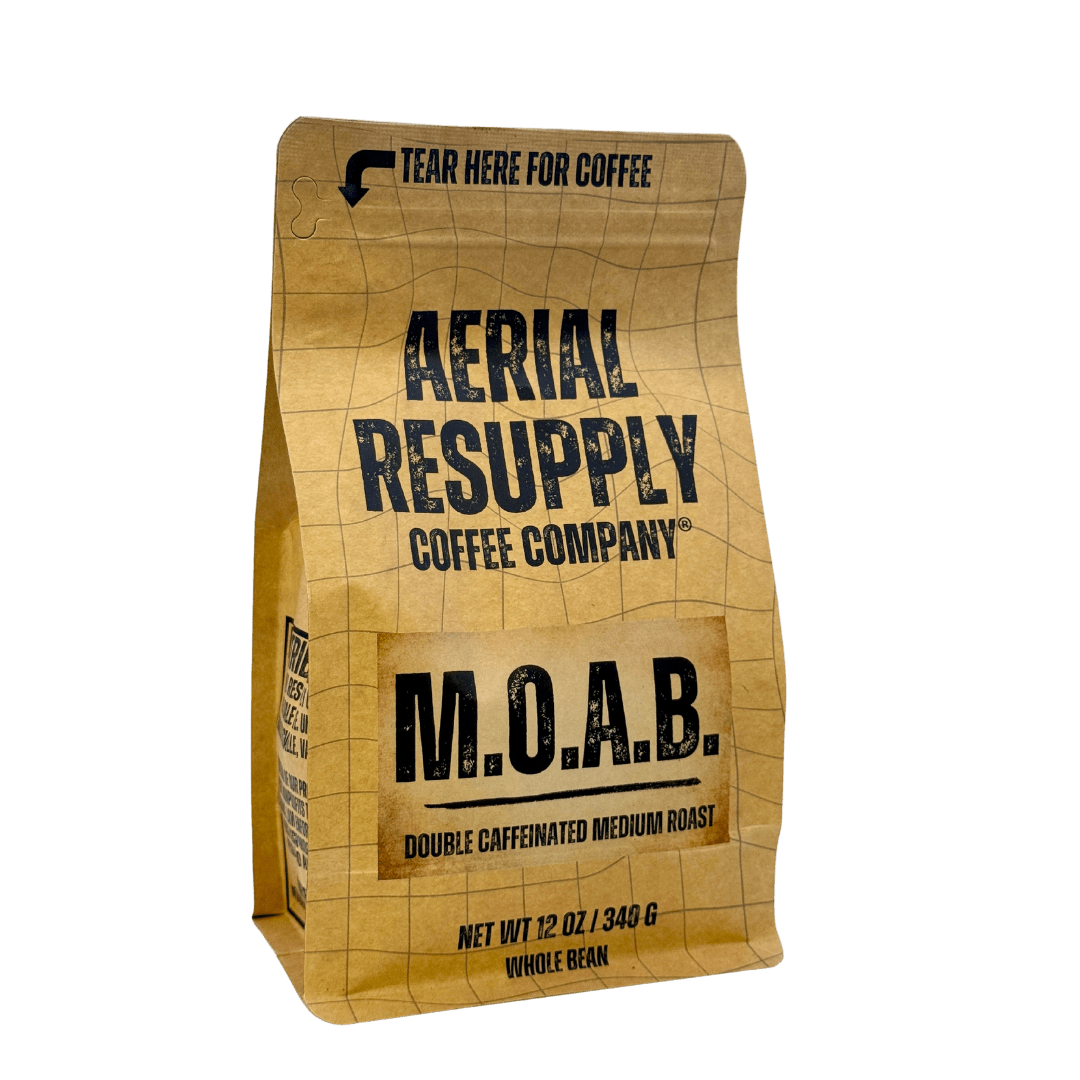
Some missions require a different standard. MOAB is ARC's double-caffeinated blend — double the caffeine, built for when the standard dose isn't cutting it. Use it at the same ratio, get more output.
Shop MOAB →Does Grind Size Affect the Optimal Coffee to Water Ratio?
Grind size affects extraction rate, not the target ratio. A finer grind extracts faster because it exposes more surface area to the water. A coarser grind extracts more slowly. If your grind is off, you'll hit the right ratio by weight but still produce an under- or over-extracted cup because the contact time and surface area are mismatched to your brew method.
The practical rule: match your grind to your brew method first, then dial in the ratio. French press gets coarse. Pour over gets medium. Espresso gets fine. Drip gets medium. If you try to fix a grind problem by changing your ratio, you end up chasing two variables at once and nothing converges.
How Do You Measure Coffee Without a Scale?
You can approximate with tablespoons. One tablespoon of medium-ground coffee weighs about 5 to 6 grams. Two tablespoons is roughly 10 to 12 grams. For a 12-oz cup at a 1:16 ratio, you need about 21 grams, which is closer to 3 to 4 level tablespoons — not the 2 tablespoons most instructions suggest.
The honest answer is that tablespoons are a rough approximation that varies with grind size and roast level. A scale is twelve dollars and it solves the problem permanently. The U.S. Army spent 20 years teaching me that imprecise measurement leads to predictable failures. Buy the scale.
What Is the Difference Between Coffee Brewing Ratio and Extraction Yield?
The brewing ratio is the input — how much coffee you use relative to how much water. Extraction yield is the output — what percentage of the coffee's total dissolvable mass ended up in the cup. The SCA target for extraction yield is 18 to 22%. The golden ratio is designed to hit that window under normal brewing conditions.
If you want to measure extraction yield directly, you need a refractometer, which measures the TDS (total dissolved solids) of the finished brew. Most home brewers don't need this. The golden ratio plus a gram scale gets you to the same place without the equipment.
The logistics version: the ratio is your input control, extraction yield is your quality control check. Dial in the input and the output takes care of itself 90% of the time.
Frequently Asked Questions
How much coffee do I use for a 12-cup drip coffee maker?
A standard 12-cup drip maker holds about 60 ounces of water, which is roughly 1,800 grams. At a 1:16 ratio, that's about 112 grams of ground coffee — closer to 18 to 19 tablespoons. Most people use half that and wonder why the pot tastes like warm disappointment. Weigh your coffee. It takes 30 seconds and solves the problem for good.
Is the coffee to water ratio the same for whole bean and pre-ground coffee?
Yes. The ratio is based on weight, and a gram of whole bean and a gram of ground coffee weigh the same. The difference comes in grind consistency — freshly ground beans extract more evenly than pre-ground coffee that's been sitting in a bag for three months. The ratio is constant. The freshness is a separate variable that also matters.
What ratio should I use for stronger coffee?
Drop the ratio to 1:14 or 1:13. That's about 70 to 75 grams per liter of water instead of the standard 60 to 65. You'll get a more concentrated, bolder cup. Keep water temperature and brew time the same and just increase the coffee dose. If the cup tastes bitter rather than strong, you've gone too far — back off the dose slightly and try again.
Can I use the same ratio for iced coffee as hot coffee?
Not if you're brewing directly over ice. When you brew hot coffee over ice, the melt water dilutes the cup by roughly 25 to 30%. Compensate by using a stronger ratio — around 1:10 to 1:12 for the hot brew, then pour directly over ice. The final diluted ratio lands right back in the 1:15 to 1:16 range. This is called the Japanese iced coffee method and it's the fastest way to get quality iced coffee.
Does the coffee to water ratio change for dark roast vs. light roast?
The target ratio stays the same, but dark roast beans weigh slightly less per volume than light roast beans because the roasting process drives off more moisture. If you measure by weight, the ratio accounts for this automatically. If you measure by scoops, a scoop of dark roast delivers fewer grams than a scoop of light roast. Another reason to use a scale.
Get the ratio right and you'll never blame the beans again. Start with something worth measuring.
First subscription order ships at 30% off with code FLY30.