
Somewhere in 1992, a very kind man named Gary Chapman sat down and wrote a book explaining that people express love in five different ways: Words of Affirmation, Acts of Service, Receiving Gifts, Quality Time, and Physical Touch. It sold millions of copies. It saved marriages. Oprah probably talked about it. Good for Gary.
Gary Chapman has almost certainly never been awoken at 0400 by someone banging a metal trash can down a hallway. He has likely never eaten a cold MRE in the rain while someone three feet away complained that it was, somehow, also their worst day ever. He has, in all probability, never looked a fellow human being directly in the eyes and communicated genuine, unconditional love through an insult so specific and so deeply personal that it required years of research to construct.
Gary's framework is wonderful for the general population. But veterans didn't come home from general population experiences. They came home from places where "I care about you" sounded like "move, I'll do it," and "I missed you" sounded like "you look terrible, what happened to your face." Where showing up at midnight unannounced with coffee and zero explanation was the explanation. Where someone stealing your food was actually the highest compliment, because it meant they were comfortable enough to commit a crime in your presence.
So. With love, respect, and a complete absence of apology: here are the 5 Veteran Love Languages. Gary, this one's not for you, buddy. You're doing great, though.

#5 — The Corrective Knife-Hand
Gary Chapman says Physical Touch is about warmth and comfort — a hand on your shoulder, a reassuring squeeze, the gentle reminder that another human being is physically present and cares about your wellbeing. That's adorable. That is also not what happens.
What happens is this: you are in the middle of doing something wrong — maybe you don't even know you're doing something wrong — and without warning, without preamble, without so much as a cleared throat, a veteran grabs the back of your neck with the grip of someone who has carried a rucksack for twenty miles and now has opinions about how you're living your life. Or a flat palm comes from the side and connects with your chest hard enough to reset your attitude. The accompanying eye contact says everything else: I am glad you are breathing. I am personally offended by the choices you just made. These two feelings coexist in me simultaneously and I have made peace with that.
The knife-hand itself — that flat, rigid, officer-silencing, briefing-room-dominating blade of a gesture that has ended more arguments than words ever could — is not a threat. It is a declaration of investment. It is a veteran saying: "I see exactly what is happening here. I have opinions about it. I am the one who is going to fix this because I care about the outcome more than I care about how I look right now." You only knife-hand people you're willing to go to bat for. The people they don't care about? They just let those people figure it out the hard way. And honestly, sometimes that's the kinder option.

#4 — Shared Misery
Gary Chapman wants Quality Time to feel good. He envisions presence, connection, intentional togetherness free from distraction. Eye contact over a meal. A walk without phones. Meaningful conversation that leaves both people feeling seen and nourished.
Veterans have a version of that. It looks like two people in a freezing garage at 0200, sitting in camp chairs that have seen better decades, surrounded by the faint scent of motor oil and old decisions, talking about how everything is a disaster. Not brainstorming solutions. Not processing feelings toward any kind of resolution. Not growing. Just two people choosing, completely voluntarily, to be cold and exhausted and vaguely despairing at the exact same time, in the exact same location, because the other option is doing it alone and that's worse. The bar is low. The bond is unbreakable.
The thing is, a veteran who shows up at midnight when you text "I can't sleep" didn't have to be there. They had warm beds. They had options. They chose the freezing garage because somewhere in the part of their brain that got rewired by years of shared suffering, "staying" is the language they speak fluently and leaving is the thing they don't do. You want to know who someone actually is? Watch who shows up when it's inconvenient, cold, and there's no reward. That's your answer right there, sitting in a camp chair, complaining about everything, refusing to leave.
 #3 — Aggressive Competence
In the civilian world, helping someone with a task involves a series of polite social exchanges. "Do you need a hand?" "Oh I don't want to bother you." "No, really, I'd be happy to." "Are you sure?" "Absolutely." Somewhere in this little dance, someone eventually gets help, and everyone feels good about the process and themselves.
Veterans find this exhausting and move immediately to the part where the problem is fixed. There is no offer. There is no asking. There is a sudden absence of whatever tool you were holding, a veteran now doing the thing correctly and at speed, and you standing there with empty hands processing what just happened. Maybe they make a sound that functions as an explanation — something like "move" or "give me that" or the sound someone makes when they've been watching a situation deteriorate past the point where silence is still an option. Maybe they say nothing at all. Either way, the task gets done, and something unspoken just passed between the two of you: I cannot watch you suffer through this. I am physically incapable of standing here and letting this continue. You matter enough that your incompetence is my problem now.
Civilians sometimes find this rude. Veterans recognize it as a declaration. There are people in this world a veteran will stand back and watch fail completely without lifting a finger, because why would they? But the people they love? Those people will never be allowed to struggle visibly within arm's reach. That's just not how it works. Get used to the wrench being taken out of your hands. It means you're family.

#2 — Tactical Acquisition
There is a version of gift-giving that involves wrapping paper, ribbons, and a heartfelt card. Veterans are familiar with this version because they've seen it in movies. What they actually practice is something far more efficient and significantly more legally ambiguous.
The veteran gift appears without announcement. One day you mention, offhand, that you need a specific tool, or a piece of gear, or just something that would make your life marginally better. You say it once. You probably forget you said it. Three weeks later, the thing is on your workbench with no note, no explanation, and no receipt because receipts are for transactions that actually took place in a store. When you ask where it came from, the answer will be some variation of "found it," which is veteran for "I was in a position to acquire this and I thought of you and I made a command decision." The item may have previously belonged to someone your veteran doesn't like. This is, in fact, a bonus. You're not just getting a gift — you're getting a gift that also functions as a tactical redistribution of resources away from an enemy and toward someone they love. That's not one gesture. That's two.
The whole thing requires that your veteran was thinking about you when you weren't there. That they remembered something you said. That they acted on it without being asked, without expecting thanks, and without needing you to know the full operational details. That is, by any reasonable measure, love. Strange, probably not entirely above-board love — but love.

#1 — Creative Defamation
And here it is. The crown jewel. The love language that has ended more civilian friendships by accident than any other, because a veteran deployed it without warning on someone who wasn't briefed on the rules of engagement.
You haven't seen each other in eight months. Maybe longer. You spot each other across a parking lot, a bar, a family barbecue. Normal people in this situation hug. They say "it's so good to see you." They ask how things are going with some expectation of an honest answer. What a veteran does instead is immediately and with zero wind-up launch into a comprehensive audit of everything that has visibly deteriorated about the other person since they last saw them. The hairline. The weight. The life choices. The career. The car. The way they're standing right now, actually — what is that, did something happen to their back? This assessment is delivered at full volume, in front of people who have known one or both of them for years, with the calm confidence of someone who has been workshopping this material since the moment they knew they'd see each other again.
"If they don't greet you by questioning your genetic lineage and mocking your hairline, they don't actually like you. The deeper the insult, the stronger the bond."
Here is what civilians miss: building a truly devastating insult requires homework. You have to know someone. You have to have been paying attention — to the specific texture of their failures, the particular shape of their insecurities, the exact thing they're most sensitive about this year. Generic insults are for strangers. "You look bad" takes three seconds and means nothing. But a nickname so precise and so perfectly aimed that it follows a person across three duty stations, two marriages, and a decade of group texts? That required investment. That required someone who cares enough about you to catalog your weaknesses over years and then weaponize them with the kind of accuracy that can only come from love.
The funniest insult lands because it's true. It's only true if someone has been paying close enough attention to know. And if someone has been paying that much attention for that long and still shows up? That's not cruelty. That's the longest, most obnoxious love letter ever written.
So What Does All of This Mean?
It means that somewhere out there, a veteran is showing someone they love them in a way that is completely unrecognizable to anyone who didn't serve. They're grabbing someone's neck. They're fixing something without asking. They're handing over an object with an unclear chain of custody. They're sitting in a cold garage at 2 AM not because it's fun but because they will not let someone sit in a cold garage alone. And they are greeting their closest friends with language that, taken out of context, sounds like the beginning of an HR complaint.
All of it means the same thing. Every single time.
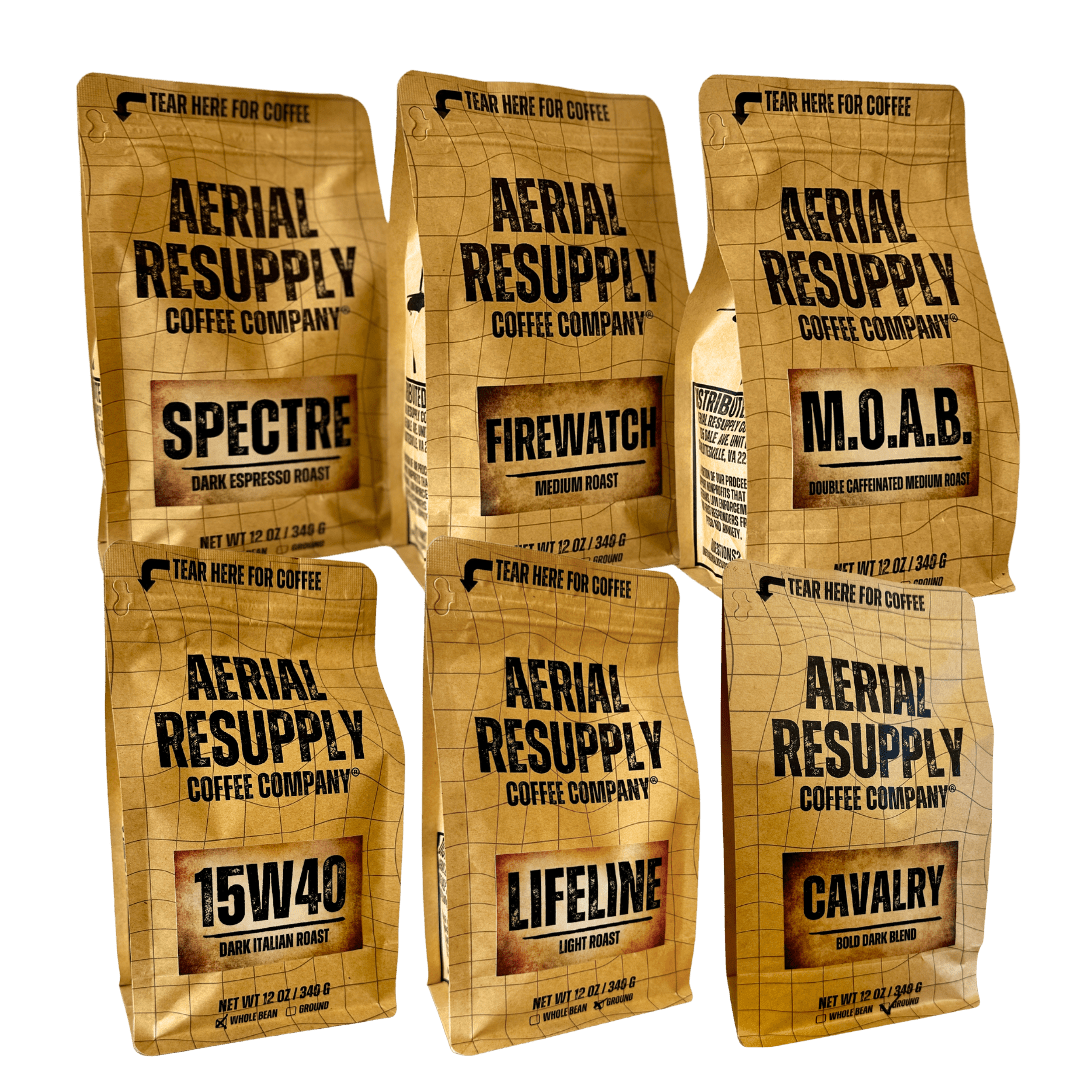
We built Aerial Resupply Coffee because we understand that sometimes love is just showing up with something hot, strong, and completely unexplained. No ceremony. No bow. Just: here, you need this, I knew before you did. Whether that's Firewatch for the people who are easy to love, Spectre for when things need to get handled, or 15W40 for the nights that require the kind of coffee that looks a doctor in the eye and lies — coffee is how veterans say the things they haven't got words for.
Gary Chapman wrote a beautiful book. But he left a few chapters out.
We've got those chapters.
Built for people who show love in ways that require a translator.